
FAO: Africa Conference on Sustainable Agricultural Mechanisation
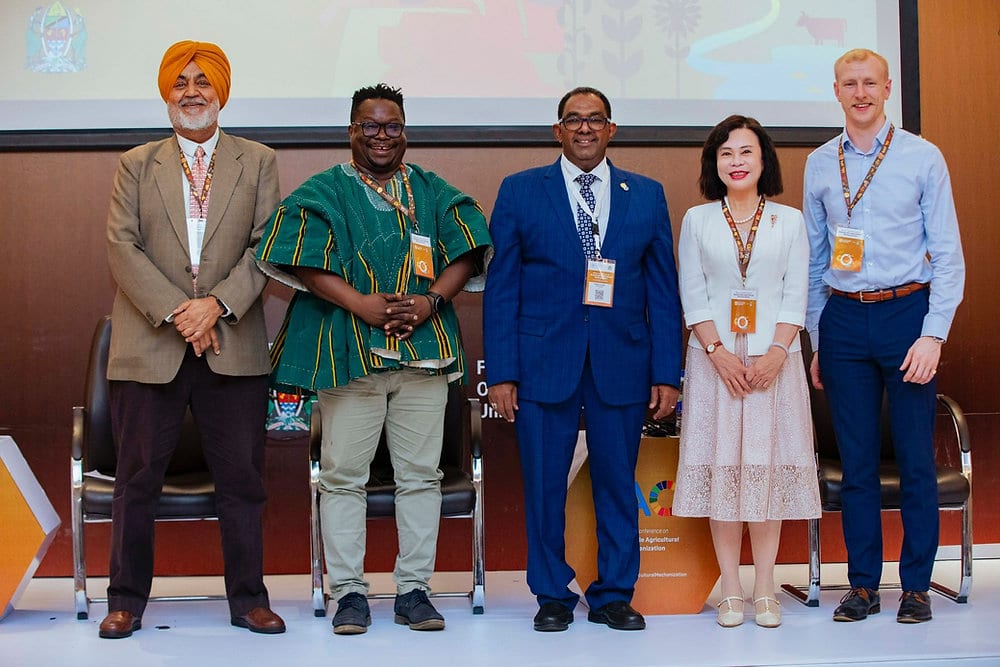
Jacob Lavin spoke at the first Africa Conference on Sustainable Agricultural Mechanization in Tanzania, on combining technological innovation with local knowledge.
In the first week of February, Jacob Lavin had the pleasure of speaking about Aftrak's collaborative practice of combining technological innovation with local communities to drive sustainable mechanisation, at the first Africa Conference on Sustainable Agricultural Mechanization (ACSAM).
Organised by the Food and Agriculture Organization of the UN in collaboration with the Government of the United Republic of Tanzania, the conference provides a neutral space for farmers, mechanisation service providers, research institutions, development agencies, policymakers, extension specialists, civil society, opinion leaders and the private sector to engage in open dialogue, exchange experiences and explore new pathways for accelerating sustainable agricultural mechanisation.
Why mechanisation?
Mechanisation in agriculture is essential to addressing Africa's deepening food insecurity, where over 307 million people face hunger and childhood malnutrition remains alarmingly high. Many farmers still rely on labour-intensive methods, limiting productivity, resilience to climate change, and the ability to produce sufficient, nutritious food. Sustainable Agricultural Mechanisation improves efficiency, reduces physical strain, and enables the adoption of climate-smart and resource-conserving practices.
Aligned with the FAO Strategic Framework 2022–2031 and initiatives such as the Comprehensive Africa Agriculture Development Programme and the Southern African Development Community roadmap on mechanisation, it is increasingly recognised as a key driver of rural transformation. By integrating digital innovation, strengthening supply chains, and fostering investment and partnerships, mechanisation supports long-term agricultural growth, economic opportunity, and sustainable development across the continent.
Power in partnership
Formed in 2023 and incorporated in May 2024, Aftrak was built on the belief that sustainable mechanisation must be powered by partnership. Rather than imposing a purely mechanical fix to food poverty and energy access, Aftrak collaborated from the outset — bringing together engineers from Loughborough University to co-design micro electric tractors and solar microgrids as an integrated “economy in a box”, working with CBI to ensure battery expertise, scale-up strategy and commercial viability, and partnering closely with Tiyeni Malawi to ground the innovation in local agricultural knowledge.
Through farmer-led field trials and continuous feedback, the tractor was refined to support Deep Bed Farming, meeting the real demands of breaking hardpan soil while reducing labour burdens for women and elderly farmers. This listen–adapt–redesign methodology defines Aftrak's identity: technology shaped by local insight, strengthened by technical excellence, and sustained through shared ownership. As Aftrak scales, it continues to prioritise partnerships with local SMEs, cooperatives and educators, ensuring that mechanisation is not delivered to communities, but built with them.
“Aftrak's journey shows that true power lies not just in batteries or machinery, but in partnership. When innovation is guided by local knowledge, mutual respect, and shared ownership, mechanisation becomes empowerment — and no one is left behind.”